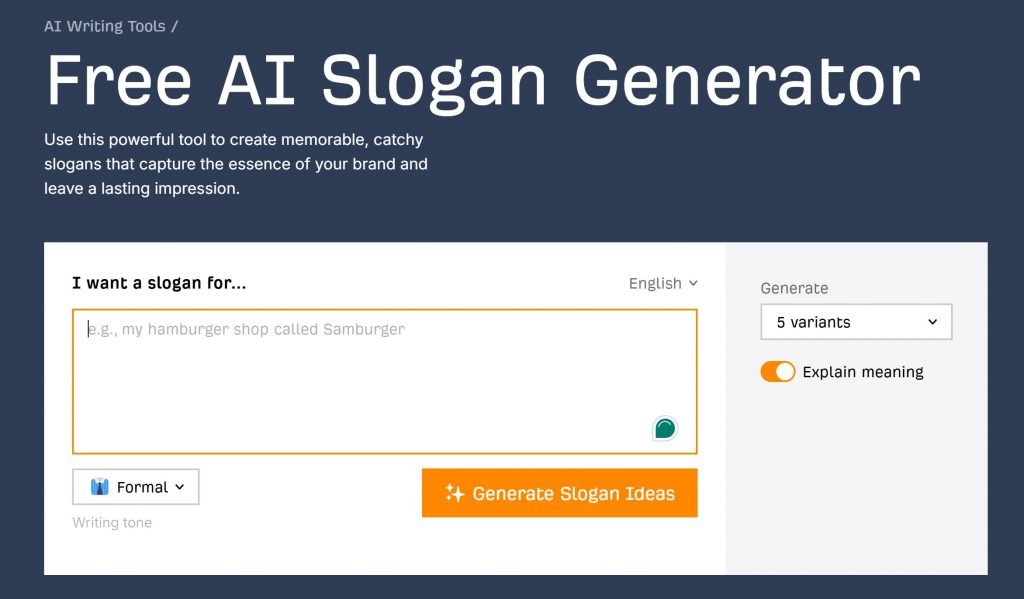
The quest to distill a brand's essence into a memorable, impactful phrase has always been a blend of art and science. But what happens when the science side gets a turbocharge? We're witnessing a seismic shift with AI in Slogan Generation: Tools and Future Trends, revolutionizing how businesses craft their linguistic identities. This isn't just about automation; it's about intelligence amplifying creativity, making the arduous task of defining a brand's voice more accessible, efficient, and deeply resonant.
Gone are the days when a standout slogan was solely the product of a grueling brainstorming session and a stroke of human genius. While human ingenuity remains paramount, artificial intelligence has emerged as a transformative co-pilot, fundamentally reshaping slogan creation and testing. By 2025, AI is poised to become an indispensable cornerstone in brand marketing, driving strategies that are not just catchy, but also smart, minimal, and profoundly human.
At a Glance: AI's Impact on Slogan Generation
- Speed & Scale: AI generates hundreds of slogan variations in seconds, not weeks, drastically cutting time and costs.
- Data-Driven Precision: Algorithms analyze vast datasets to identify emotional triggers, linguistic patterns, and consumer trends.
- Personalization: AI tailors slogans for niche audiences while ensuring brand consistency.
- Minimalism & Emotion: Future slogans will be short, sharp, globally appealing, and deeply connected to human emotions.
- Human-AI Collaboration: AI provides the fuel, but human oversight is crucial for cultural sensitivity and brand alignment.
- Dynamic Evolution: Slogans are becoming adaptable, changing with user choices or cultural moments for ongoing relevance.
- Holistic Branding: AI tools are merging slogan generation with visual storytelling, offering cohesive brand experiences.
Beyond Brainstorming: The AI Revolution in Slogan Creation
Imagine distilling years of market research, linguistic expertise, and psychological insights into a single, intuitive platform. That's the promise of AI in slogan generation. It's not just about spitting out random words; it's about intelligent synthesis. AI-powered generators and predictive analytics are refining messaging, gauging emotional impact, and personalizing slogans for niche audiences, all while maintaining brand consistency. This technological leap means businesses of all sizes, from startups to global enterprises, can access sophisticated branding tools previously reserved for those with immense budgets and timelines.
The engine powering this revolution? Advanced Natural Language Processing (NLP) models, like OpenAI's formidable GPT-5, which can analyze vast datasets, consumer trends, and linguistic patterns with astonishing speed. These models excel at identifying emotional triggers, pinpointing brevity, and even recognizing rhythmic phrasing that makes a slogan inherently memorable.
The Core Mechanisms: How AI Crafts Catchy Phrases
At its heart, AI slogan generation operates by learning from an immense corpus of successful (and unsuccessful) language. It's like having a hyper-efficient literary apprentice who's read every best-selling ad copy, every viral tagline, and every evocative poem.
- Data Ingestion & Analysis: AI systems consume massive amounts of text data – marketing campaigns, social media trends, competitor slogans, consumer reviews, even poetry and literature. They learn what makes language "work" in different contexts.
- Pattern Recognition: The algorithms identify recurring patterns:
- Emotional Triggers: What words and phrases evoke joy, trust, urgency, or empowerment?
- Brevity and Conciseness: How to say the most with the fewest words, a hallmark of effective branding.
- Rhythm and Alliteration: The musicality of language that makes slogans sticky and easy to recall.
- Target Audience Nuances: How language varies for different demographics, cultures, or psychographic profiles.
- Generative Capabilities: Using these learned patterns, the AI can then generate entirely new slogans. This isn't just mixing and matching; it's creating novel combinations that adhere to the identified success metrics. For example, if you input "eco-friendly fashion brand," the AI might suggest variations that emphasize "sustainable style," "conscious couture," or "planet-first threads," each with slightly different emotional weights.
- Optimization & Refinement: Modern AI tools aren't just one-shot generators. They often include features for real-time market analysis and sentiment prediction, allowing users to test variations against predicted consumer responses. This data-driven optimization is a game-changer, moving slogan creation from guesswork to informed strategy. If you're looking for an immediate assist, Our catchy slogan generator can help you brainstorm compelling options based on your core ideas.
This entire process, which once took days or weeks of human effort, now happens in mere seconds, offering unparalleled cost-effectiveness and scalability for generating hundreds, even thousands, of testable variations.
More Than Words: AI and the Art of Minimalist, Emotional Branding
The future of branding isn't just about being seen; it's about being felt and remembered. The research clearly indicates that future logo slogans will be shaped by a powerful triumvirate: AI, minimalism, and emotional resonance. This fusion translates into branding that is smart, minimal, and deeply human.
Minimalism in branding emphasizes clarity and confidence. Think of slogans like "Just Do It" or "Think Different" – short, sharp, and profound. These aren't just pithy; they're strategically concise, stripping away excess to promote global appeal via easily translatable phrases. AI assists in this by identifying the most impactful core words and phrases, cutting through jargon to get to the essence. It understands that in a noisy world, less is often more.
But brevity without soul is just emptiness. Despite all the technological advancements, human connection remains central. Effective slogans transcend mere information; they inspire emotions like hope, joy, empowerment, or belonging. Authenticity, now more than ever, is crucial for a slogan's stickiness. AI can analyze millions of data points to understand what evokes these emotions, but it's the human touch that ensures the resulting phrase feels genuine and aligns with the brand's true values.
Weaving Emotion and Economy with Algorithms
How does AI manage this delicate balance?
- Emotional Lexicon Mapping: AI models learn the emotional associations of words and phrases. When given a brand's desired emotional outcome (e.g., "trust," "innovation," "comfort"), the AI can suggest language that aligns with that sentiment.
- Cross-Cultural Linguistic Analysis: For global brands, AI can help identify phrases that retain their core meaning and emotional impact across different languages and cultural contexts, which is critical for minimalist slogans designed for wide appeal.
- Feedback Loops: The best AI tools aren't static. They learn from user input and market performance. If a slogan emphasizing "joy" performs well in A/B tests, the AI system refines its understanding of "joyful" language within that brand's context.
This increased accessibility means that even small businesses can leverage sophisticated tools to craft slogans that resonate deeply, leveling the playing field in competitive markets.
Key Tools and Platforms Shaping the Slogan Landscape
While general-purpose AI writing tools can certainly generate slogans, specialized platforms are emerging that offer far more nuanced and powerful capabilities. These tools move beyond simple word concatenation to offer holistic branding solutions.
Consider the capabilities that define the cutting edge:
- Predictive Analytics: Beyond generation, these tools analyze the potential impact of a slogan. They can predict how consumers might react, what emotions it evokes, and its likelihood of memorability.
- Brand Voice Training: The most advanced platforms allow users to "train" the AI on their specific brand voice, existing marketing materials, and target audience profiles. This ensures that the generated slogans aren't generic but are deeply aligned with the brand's established identity and communication style.
- Integration with Marketing Stacks: Seamless integration with other marketing tools (like social media schedulers, ad platforms, or CRM systems) allows for rapid deployment and testing of slogans in real-world campaigns.
Mini Case Study: Reelmind.ai – A Glimpse into the Future
Platforms like Reelmind.ai exemplify this shift, showcasing a holistic approach to AI-powered branding. They don't just generate slogans; they integrate AI slogan generation with visual storytelling, offering a cohesive and powerful message. - Visual Reinforcement: Reelmind.ai pairs AI-generated slogans with custom AI video and image editing, ensuring that the visual and verbal elements of a brand's message are perfectly aligned and mutually reinforcing. This creates a much stronger, more memorable brand impression.
- Model Training & Customization: Users can train the AI on their specific brand voice, values, and aesthetic. This personalized approach means the AI acts as an extension of the brand's marketing team, not just a generic idea generator.
- Community Collaboration: Some platforms foster communities where creators can share feedback, test slogan performance, and refine models collaboratively. This taps into collective intelligence to further enhance AI output.
- Monetization Opportunities: For creators and agencies, the ability to train high-performing slogan models and offer them for use within the platform opens new avenues for monetization. It turns expertise into a scalable product.
These integrated solutions highlight that AI isn't just a slogan generator; it's becoming a comprehensive branding partner.
The Future Isn't Static: Dynamic Slogans and Adaptive Branding
In an age of constant flux, brand relevance is a moving target. The future of slogans reflects this reality, evolving beyond fixed taglines to embrace dynamism. Imagine a slogan that adapts to a user's choices, reflects current cultural moments, or even changes based on geographic location. This is the promise of dynamic slogans.
These adaptive phrases ensure brand relevance without losing core identity. For instance, a coffee brand might have a core identity slogan, but its AI-powered campaigns could generate localized variations ("Your Morning Fuel," "Afternoon Pick-Me-Up," "Late-Night Comfort") or culturally responsive ones during specific holidays or events. This level of responsiveness was previously impossible at scale. AI enables brands to engage in interactive campaigns where the slogan itself can be a point of engagement, reacting to user input or real-time data.
Navigating the Nuances: Human Oversight and Ethical AI
While AI excels at pattern recognition, data processing, and rapid generation, it operates without human intuition, emotional intelligence, or cultural sensitivity. This is precisely why human oversight remains not just important, but essential.
The challenges are real:
- Genericity: Without proper guidance, AI can produce slogans that are bland, generic, or indistinguishable from competitors.
- Repetition: Algorithms might fall into repetitive patterns if not adequately fine-tuned.
- Misleading or Offensive Content: AI can inadvertently generate slogans that are culturally insensitive, politically incorrect, or even offensive, especially when dealing with nuanced language or humor across diverse demographics.
- Lack of Context: AI might miss the subtle context of a brand's story or current market events, leading to irrelevant suggestions.
Platforms mitigate these risks through advanced fine-tuning options, allowing users to guide the AI's output, establish guardrails, and implement ethical guidelines. But ultimately, the discerning eye and ethical compass of a human marketing expert are irreplaceable.
The Imperative of Brand Consistency and Cultural Fit
Human input serves several critical functions:
- Cultural Vetting: A human can catch nuances that an AI might miss, preventing potentially damaging cultural missteps.
- Brand Alignment: Ensuring the slogan authentically reflects the brand's core values, mission, and personality. Does it feel right? Does it sound like us?
- Emotional Depth: While AI can identify emotional triggers, a human can ensure the slogan truly resonates with the desired emotion, making it profound and memorable, not just technically correct.
- Creative Spark: Often, the AI provides a solid foundation, but a human takes that foundation and adds the truly innovative, unexpected twist that elevates a slogan from good to iconic.
Think of AI as an incredibly powerful engine, and the human as the skilled driver and navigator. Both are essential for reaching the desired destination safely and effectively.
What to Look for in an AI Slogan Generator (And What to Avoid)
Choosing the right AI tool is crucial. Not all generators are created equal.
Key Features to Prioritize:
- Customization & Fine-Tuning: The ability to provide extensive input about your brand, target audience, desired tone, and specific keywords. Can you exclude certain words or concepts?
- Brand Voice Training: Look for tools that allow you to "train" the AI on your existing brand content to ensure consistent output.
- Sentiment Analysis & Predictive Metrics: Tools that can predict the emotional impact or potential market performance of generated slogans.
- Multiple Variations & Iteration: Generates a wide array of options and allows for easy iteration and refinement.
- Speed & Scalability: How quickly can it generate a large volume of high-quality suggestions?
- Integration Capabilities: Does it play well with other marketing platforms or offer APIs for custom integrations?
- User Interface & Experience: Is it intuitive and easy to use, even for non-technical users?
Red Flags and Pitfalls to Avoid: - Generic, Repetitive Output: If the tool consistently generates bland, uninspired, or overly similar slogans, it's not leveraging AI effectively.
- Lack of Control: If you can't guide the AI or provide feedback to refine its suggestions, it will likely produce irrelevant results.
- Hidden Costs/Unclear Pricing: Be wary of models that aren't transparent about usage limits, credit systems, or premium features.
- Poor Ethical Framework: Does the platform address potential biases in its data or offer features to prevent offensive content?
- Over-reliance on Keywords: A tool that simply stuffs keywords into sentences isn't truly intelligent; it's a glorified thesaurus.
Your Role in the AI-Powered Future of Slogans
The emergence of AI in slogan generation isn't a threat to human creativity; it's an unprecedented opportunity to elevate it. Your role evolves from being the sole creator to becoming a strategic curator, an intelligent editor, and a creative director.
- Define Your Brand's North Star: AI can't invent your brand's core purpose, values, or unique selling proposition. Before you even touch a generator, be crystal clear about who you are and what you stand for. The better your input, the better the AI's output.
- Be a Smart Editor: Treat AI suggestions as raw material. Your job is to sift, refine, combine, and infuse them with the human spark. Sometimes, the AI will give you 90% of the way there, and you'll provide the crucial 10% that makes it brilliant.
- Experiment Fearlessly: The speed and low cost of AI generation mean you can test far more variations than ever before. Don't settle for the first good idea; explore the boundaries.
- Provide Intelligent Feedback: The more you interact with an AI tool, guiding its output and indicating preferences, the better it becomes at understanding your brand's specific needs. You're not just using a tool; you're teaching it.
- Focus on the "Why": AI can handle the "what" (generating slogans), but you must constantly bring the "why" – the emotional resonance, the cultural context, the strategic purpose.
Frequently Asked Questions About AI in Slogan Generation
Can AI replace human copywriters for slogans?
No. AI is a powerful assistant and accelerator, but it cannot fully replace human creativity, emotional intelligence, cultural nuance, or the strategic understanding of a brand's long-term vision. Human oversight is essential for authenticity, ethical considerations, and true brand alignment. AI augments human capabilities; it doesn't eliminate them.
How accurate is AI in predicting slogan effectiveness?
AI's accuracy in predicting effectiveness is rapidly improving thanks to advanced predictive analytics and sentiment analysis. By analyzing vast datasets of past campaigns and real-time market data, AI can offer highly informed predictions. However, market dynamics are complex and influenced by many unpredictable factors, so human judgment and real-world testing (like A/B testing) remain crucial for final validation.
Is AI-generated content safe from copyright issues?
The legal landscape around AI-generated content and copyright is still evolving and varies by jurisdiction. Generally, if an AI is simply mimicking existing styles or patterns, copyright issues might be minimal. However, if an AI directly copies or heavily reproduces a copyrighted work, issues could arise. The key is typically the element of human originality and creation. For slogans, especially short phrases, copyright protection is often limited unless they are part of a larger copyrighted work or protected by trademark. Always perform due diligence and consult legal advice regarding trademarking any final slogan.
What are the main costs associated with AI slogan tools?
Costs vary widely. Many basic AI slogan generators are free or offer freemium models with limited usage. More advanced platforms with features like brand voice training, predictive analytics, extensive customization, and integration capabilities often come with subscription fees, tiered pricing based on usage, or enterprise-level contracts. Factor in potential costs for premium features, API access, and ongoing data storage or model training.
Ready to Ignite Your Brand's Voice?
The landscape of brand communication is rapidly evolving, and AI is no longer a futuristic concept but a present-day partner. By embracing the power of AI in slogan generation, you're not just streamlining a process; you're unlocking new levels of creativity, efficiency, and resonance for your brand.
This isn't about letting machines take over; it's about empowering your strategic vision with intelligent tools. So, whether you're launching a new venture, revitalizing an existing brand, or simply looking to refresh your messaging, consider how AI can be the catalyst to find that perfect phrase. The future of branding is collaborative, intelligent, and, most importantly, compelling. Are you ready to lead the conversation?